

Global Red Tab™ System
Consolidating regional loyalty experiences into one globally scalable pattern system.
Levi Strauss & Co.
Site + App + Store
Global
March – June 2025
Overview
Levi’s Red Tab™ is a global loyalty program that was delivered as many separate ones. Regions and channels each designed, wrote, and shipped their own version, so the same program looked and read differently depending on where a fan met it. I led the effort to replace that with one system, built once and executed locally. Today, 17 countries run on the global framework, with more joining over the next year.
My role
I led cross-functional discussions and workshops, designed the visuals, experiences, and prototypes, and crafted every element not sourced from the design system. I partnered with regional business teams, global brand, product and engineering.
Guiding principles
One global program, executed locally, through the lens of scale, efficiency, best practice, and brand consistency.
A fan experience that feels consistent and elevated.
The problem
We were a global team serving independent regions and channels. App never coordinated with site, and Europe and the US rarely looked at each other. Nobody chose inconsistency; it was the default result of how we were organized. An audit of every loyalty touchpoint showed the result.
10+
registration experiences on the US site alone
~20
unique loyalty touchpoint designs
7
copy variants for a single benefit, across 7 benefits whose lists also varied

A sample of loyalty touchpoints across app, mobile web, web, and registration.
That sprawl had four costs:
Inconsistent language and design. Benefits were named, ordered, and written differently on every surface.
Hidden, duplicated content. The marketing and account pages duplicated sections, and seasonal benefits lived behind login. I hypothesized that hurt their engagement.
No way to measure. The 2024 CSAT showed limited understanding of benefits (9% unaware what the benefits are), but the survey wasn’t tied to channel or entry point. With 10+ entry points, we couldn’t tell which one a member saw. If you can’t understand the consumer journey, you can’t make decisions with certainty.
Regional-only impact. As a global team serving disparate regional requests, we couldn’t do it all. We chose which region to help, so each year our impact was limited to a regional scope.
Success measures: awareness of benefits (CSAT) and reuse of global patterns.
The approach: atomic design
I built from the smallest pieces up, so every larger pattern was assembled from parts that already matched: iconography, benefit items, ordered benefit lists, page sections, and finally pages.
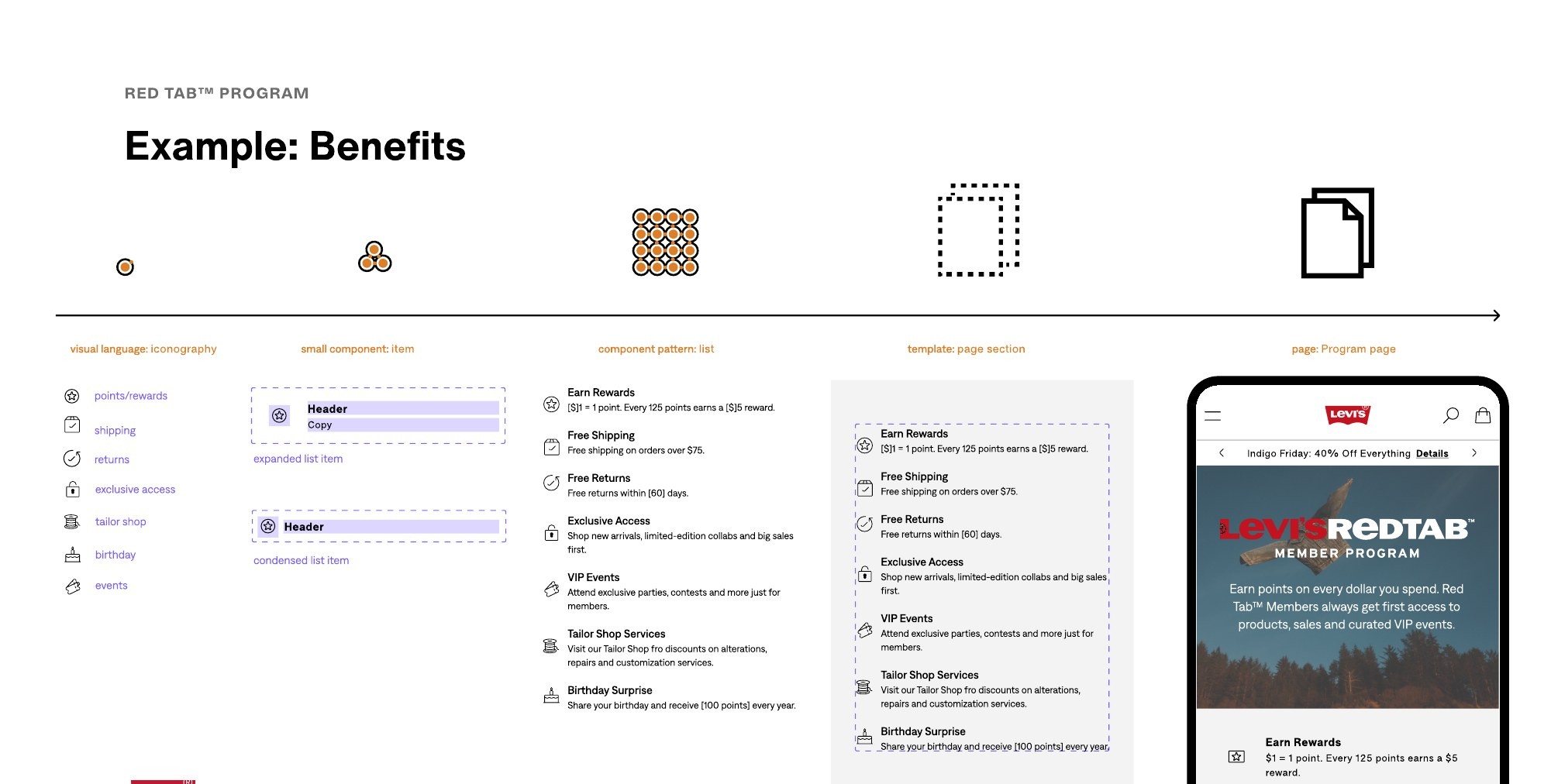
Atomic design applied to benefits: iconography, item, list, page section, page.
Language first. A global glossary sets the program name, member name, and value prop. Benefits follow a research-backed order: earn rewards and free shipping lead, birthday goes last. Global copy carries Levi’s voice for marketing; regional copy is specific, with variables swapped in per market.
Global (marketing)
Regional (digital channels)
Free shipping
Get free shipping on every order. That’s right. Every order.
Free shipping on orders over [$75].
Birthday
Celebrate your birthday with a special gift from us.
Share your birthday and receive [100 points] every year.
Clear ownership. Global provides the system (specs, patterns, usage guidelines). Regional provides the content (creative briefs for benefit launches and personalized experiences). That division gave regions defined places to flex, and it earned their buy-in: I led discussions, shared audits of the disparity, and showed a solution with clear ownership and dedicated areas of flexibility.
From patterns to pages
I built the IA around who needs what. Potential members learn about core and seasonal benefits on one ungated Program page that campaigns can link to. Returning members check points and rewards in their account.
Red Tab Program Page
Value Prop
List of Core Benefits
List of Seasonal Benefits
App Value Prop
Account: My Rewards
Point/Reward Tracker
How It Works
Frequently Asked Questions
New IA: the Red Tab™ Program page and Account: My Rewards.

Old Program page

New: guest state

New: member state
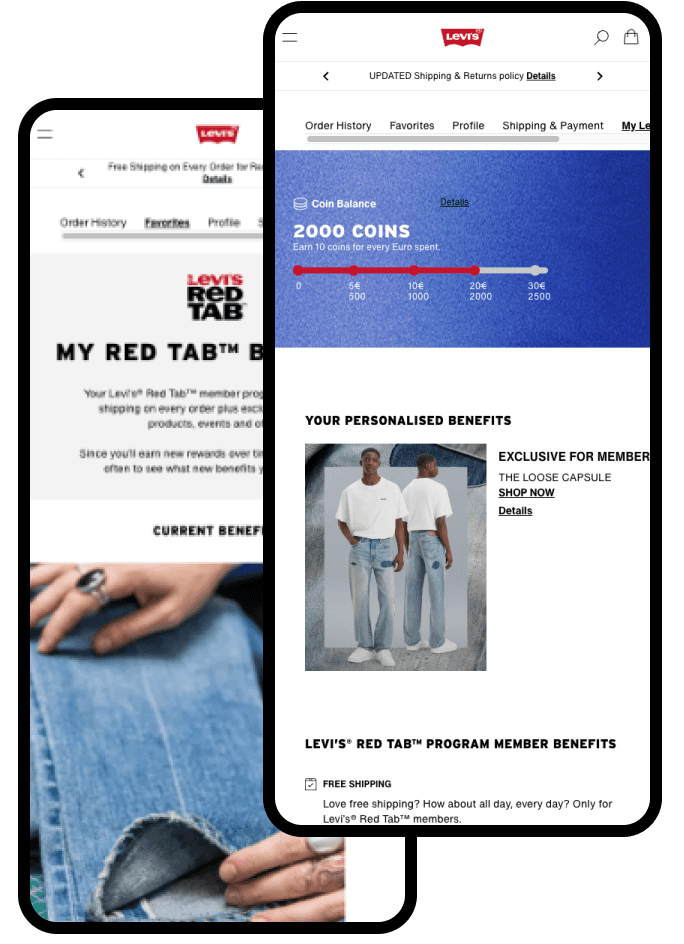
Old Account pages

New: My Rewards

New: App Account tab
The pivot
A month after launch, usability testing showed most users looked for benefit information in their account, the place we had just moved it out of. Because I had designed the pattern library to be modular, the fix was an easy update: we added the benefits list beneath the rewards information without redesigning anything.
Results
17 countries now use the global framework, with more joining next year. A solution built once reaches every region, instead of impact limited to one region at a time.
4 loyalty patterns shipped: reward tracker, benefit list, benefit list at cart, and applying rewards in cart. Two design system patterns, the strip module and image carousel, cover value props and seasonal benefits.
One language and one structure replace dozens of one-off treatments, and regional teams can link straight to the Program page from email and social to promote new benefits.
Comparable entry points make it possible to tie awareness to what a member saw.
What I learned
Fragmentation is an organizational problem before it’s a design one, and patterns are how a new way of working sticks. Consistency makes a program measurable, and a modular library means we can be wrong and fix it fast.
What's Next
Roll the patterns through the remaining registration experiences, tie awareness measurement to channel and entry point, and bring more countries onto the framework.